The complete case
The Loss Was the Receipt
A manifesto for rebuilding NC State football by fixing what has failed off the field.
NC State did not lose to Vanderbilt on September 19 because of one fumble.
The fumble was merely the final transaction.
With six seconds left, NC State led 31-28 and possessed the ball at its own five-yard line. The assignment was simple: consume the remaining time and concede a safety if necessary. Instead, quarterback CJ Bailey was hit in the end zone, forcing a fumble. Vanderbilt recovered it for a touchdown, and a game NC State had led 17-0 ended in a 35-31 loss. According to the Associated Press, teams in that situation - leading and holding the ball in the final ten seconds - had gone 1,046-1 over the previous twenty seasons. NC State became loss number two. The defeat also denied the program what would have been its first road win against an SEC opponent since 1977.1
That is the play everyone will remember. It will be replayed because it was bizarre, painful, and easy to explain: one player, one decision, one loose football.
But making that play the whole story would be another NC State mistake.
The loss was not the disease. It was the receipt.
It was the bill for years of confusing survival with success, continuity with progress, and sold tickets with satisfied customers. It was the accumulated cost of identifying a coach's floor quickly while refusing to acknowledge his ceiling until long after the evidence became overwhelming. It was the price of entering the name, image, and likeness and transfer-portal era without a visible, unified plan to create an advantage. It was what happens when leadership treats the Atlantic Coast Conference's economics as destiny instead of treating NC State's own brand, fan base, academic strengths, and place in the Research Triangle as assets to be commercialized.
This is not a manifesto about one bad play, one coach, or one athletic director. Dave Doeren is part of the story. Boo Corrigan is responsible for the era he has led. But the larger failure is institutional. For more than two decades, NC State has repeatedly failed to meet the moment off the field, then pointed to the resulting limitations on the field as though they arrived from somewhere else.
They did not.
The loss to Vanderbilt did not create the crisis. The Vanderbilt loss itemized it.
I. Philip Rivers showed us what was possible
The modern story begins with Philip Rivers because he remains the clearest evidence that NC State football's ceiling is not ordained by geography, history, or bloodline.
Rivers started for four years. In 2002, NC State went 11-3, beat Notre Dame 28-6 in the Gator Bowl, and completed the winningest season in school history. The team started 9-0. Rivers finished his career with 13,484 passing yards, won ACC Player of the Year, and set what was then an NCAA record with 51 career starts by a quarterback.2
The Rivers era was not a national dynasty. It did not produce an ACC championship. But it showed what the program could feel like when elite quarterback play, aggressive recruiting, institutional energy, and public belief converged. Carter-Finley felt consequential. NC State looked nationally relevant. The program did not have to explain why nine wins should be treated as the outer boundary of reasonable ambition.
What followed should have been the construction of a durable platform. Instead, NC State spent the next two decades repeatedly trying to preserve whatever stability it had achieved at the moment. The school behaved as though the greatest danger was losing something familiar, even when what was familiar had stopped advancing the program.
That reflex shaped the end of the Chuck Amato era, the Tom O'Brien era, and now the Dave Doeren era. It shaped contracts. It shaped facility priorities. It shaped fundraising. It shaped marketing. It shaped the tolerance for a program that could remain respectable without becoming important.
The question is not why NC State failed to reproduce Philip Rivers. Generational quarterbacks are, by definition, rare. The question is why the institution failed to use the Rivers years to build the financial, physical, and organizational machine capable of surviving after him.
Players come and go. Programs are supposed to remain.
II. NC State learned to recognize a floor and ignore a ceiling
Tom O'Brien was not a disaster. That was precisely the issue.
In six seasons, O'Brien went 40-35 overall and 22-26 in ACC play. His teams reached four bowls, although he was fired before coaching the fourth. They finished above .500 in conference play once. They produced one final AP Top 25 finish, at No. 25 in 2010. He had Russell Wilson and then Mike Glennon - two future NFL quarterbacks - and still did not reach the ACC Championship Game.3
Debbie Yow correctly recognized a ceiling. When she fired O'Brien in November 2012, she said they agreed on the goal of becoming a Top 25 program but disagreed on how to get there. As she began the search, she made the standard even clearer: NC State should be positioned to finish in the Top 25 not occasionally, but "more years than not."4
That was an ambitious and measurable standard. It also became an indictment of what followed.
Dave Doeren was hired on December 1, 2012, after going 23-4 with two Mid-American Conference championships in two seasons at Northern Illinois. Yow called him an aggressive achiever who shared NC State's goals. The university introduced a coach whose teams had scored more than 40 points in 16 of 27 games and whose 2012 offense ranked tenth nationally in scoring.5
Thirty days later, NC State lost 38-24 to Vanderbilt in the Music City Bowl. Doeren did not coach the game; interim coach Dana Bible did. Doeren attended with Yow as the next era waited to begin. On the field, the Wolfpack out-gained Vanderbilt 424-225 in total yards but committed five turnovers, four in the first half, and Vanderbilt converted those mistakes into 17 points.6
Fourteen seasons later, NC State returned to Nashville and lost to Vanderbilt again. This time Doeren was not waiting to take over. This was fully his program - his staff, his preparation, his decision, and his result.
The years between those Vanderbilt losses contain real achievements. Doeren is the winningest coach in NC State history. His teams have been regularly bowl eligible. They have produced NFL players, strong academic results, memorable wins, and four nine-win seasons. In 2025, NC State ended a five-game bowl losing streak by beating Memphis 31-7 in the Gasparilla Bowl.7
It would be unserious to erase those accomplishments.
It is equally unserious to pretend that longevity settles the question of success.
Through thirteen completed seasons, Doeren had never won ten games, never reached the ACC Championship Game, and finished in the final AP Top 25 only three times: 2017, 2021, and 2023. The 2021 team went 9-3 and finished No. 20, but its Holiday Bowl was canceled. The 2023 team finished No. 21 after losing the Pop-Tarts Bowl. The program repeatedly approached a breakthrough and stopped just short of it.8
That record is not humiliation. It is a ceiling.
NC State's institutional mistake was not failing to recognize that Doeren could establish a respectable floor. It recognized that quickly and rewarded it repeatedly. The mistake was treating the floor as evidence that the ceiling must eventually rise.
It did not.
The defense of continuity became circular: we must keep the coach because he provides stability, and the stability itself is proof the coach should be kept. But stability is only valuable when it preserves progress. Stability that preserves a ceiling is stagnation with better public relations.
The same institution that concluded six years was enough to understand O'Brien's ceiling has spent more than twice that long refusing to reach the same conclusion about his successor.
That tendency was damaging in the old version of college football. In the portal and NIL era, it is disqualifying. A program can no longer wait three years to discover whether a coach has adapted. Rosters, coordinators, quarterbacks, and financial commitments can turn over in one offseason. The floor still matters. But leadership must now identify the ceiling almost as quickly.
III. The contracts reveal what the institution valued
NC State's coaching contracts tell this story more clearly than any press conference.
Doeren's first contract was a five-year agreement worth $1.8 million annually, with significant performance incentives. That was a reasonable commitment to a rising coach. What followed was a sequence of extensions that steadily transferred leverage to the coach without requiring the program to clear the competitive thresholds NC State itself had announced.9
In 2017, after an 8-4 regular season and reported interest from Tennessee, NC State gave Doeren a five-year extension. At that point, his NC State record was 33-30 overall and 15-25 in ACC play. The Wolfpack later won the Sun Bowl and finished 9-4. Retaining him was defensible. But the episode established the pattern: the possibility that another program might want NC State's coach was treated as a threat requiring immediate protection.
The obvious question was rarely asked: protection from what?
If a coach has demonstrated that he is excellent and difficult to replace, an aggressive retention agreement can be rational. If a coach has demonstrated that he is solid but replaceable, the mere possibility of departure should not frighten an institution into surrendering leverage. NC State appears to have feared the uncertainty of a search more than it feared the certainty of the existing ceiling.
The public record does not establish how serious Tennessee's interest was or how much of it was amplified through normal agent-driven leverage. But even accepting the interest as genuine, NC State needed to ask whether losing a mid-caliber coach would be catastrophic or merely inconvenient. Very few NC State football coaches in the modern era have been hired away by more powerful programs. The institution behaved as though it faced a recurring poaching crisis that history does not support.
Then the extensions became routine.
- A new five-year agreement was announced in March 2019 after a 9-3 regular season ended in a 52-13 Gator Bowl loss.
- A contract through 2025 was approved in April 2021 after an 8-4 season ended in a Gator Bowl loss to Kentucky.
- An extension through 2026 followed the 9-3 season whose Holiday Bowl was canceled.
- A one-year extension through 2027 arrived in February 2023 after an 8-5 season ended in a Duke's Mayo Bowl loss to Maryland.
- A two-year extension through 2029 arrived in April 2024 after a 9-4 season ended in a Pop-Tarts Bowl loss to Kansas State.10
These were not all bad seasons. That is not the point. The point is that NC State repeatedly extended the horizon before the coach delivered the breakthrough the school said it wanted. Except for the 2017 extension season, the major extension cycles came after a bowl loss or, in 2021, a canceled bowl. The contract rewards moved on one calendar; the program's defining accomplishments never arrived on the other.
The 2024 agreement is the clearest example. It extended Doeren through 2029, paid $5.5 million in 2024 with annual increases, and made more than $6 million available in later years before bonuses. At the time, he had not won ten games or reached the ACC title game. The bonus schedule rewarded eight and nine wins, a bowl appearance, a Top 25 ranking, and an ACC Championship appearance - incentives layered on top of compensation already substantial by national standards.11
This is not an argument that coaches should never receive extensions after good seasons. Recruiting requires contractual runway, and the market for coaches is inflationary. It is an argument that NC State repeatedly paid for continuity without preserving sufficient flexibility for the university when continuity stopped producing progress.
The contracts reveal the true operating standard. Publicly, the goal was sustained Top 25 football. Structurally, the reward arrived for remaining bowl eligible, avoiding collapse, and generating one more year of hope.
NC State did not merely tolerate the ceiling. It financed it.
IV. College football changed, and this era belongs to Boo Corrigan
Boo Corrigan became NC State's director of athletics in April 2019. He inherited Doeren, but he did not inherit the obligation to extend him repeatedly. He inherited an old model of college football, but he has now had more than seven years to lead through the new one.12
The timeline matters.
The NCAA transfer portal began operating in 2018. The one-time transfer environment expanded dramatically in 2021. NIL rights took effect on July 1, 2021. In 2024, schools gained more freedom to help facilitate third-party NIL deals. In 2025, the House settlement opened an era of direct institutional revenue sharing, with participating schools permitted to share millions annually with athletes.13
Those changes did not merely add new responsibilities. They changed the nature of roster building. College football became a year-to-year labor market. Retention became recruiting. Evaluation speed became a competitive advantage. Coaches could no longer rely on accumulating four or five classes inside one system. Administrators could no longer treat fundraising, corporate sales, NIL, brand strategy, personnel evaluation, and coaching performance as separate departments with separate calendars.
Corrigan owns NC State's response to that transformation.
NC State has taken action. It hired Accelerate Sports Ventures as its official NIL consultancy in March 2023. It works with the One Pack NIL Collective. Its 2024-25 annual report describes athlete education, more than 100 participants at an NIL networking night, corporate-partner activations, licensed merchandise, and an above-national-average opt-in rate for NIL apparel. Those are legitimate efforts and should be credited.14
But activity is not advantage.
The question is not whether NC State has an NIL page, a consultant, a collective, or a networking event. The question is whether the program moved early enough, integrated those pieces well enough, and raised enough deployable resources to outperform its peers. The university's public record does not demonstrate that it has. It shows programs and partners; it does not show comparative market share, football roster budget, retention performance, corporate-NIL conversion, donor acquisition cost, or return on investment.
That absence matters because the modern era punishes hesitation. A slow decision does not merely cost one recruiting class. It can cost the quarterback, the replacement quarterback, the offensive lineman protecting him, and the coordinator who would have built the system around them - all in the same offseason.
NC State cannot respond to a high-velocity market with a low-velocity organization.
Corrigan has had enough time to be evaluated on results, not intentions. His tenure includes major success across the department: national and conference championships, Final Fours, a College World Series appearance, excellent academic outcomes, and five consecutive Top 25 Directors' Cup finishes through 2024-25. Those accomplishments are real, and any fair critique must say so.15
But football is not just one of twenty-plus sports. It is the largest recurring commercial platform the department controls. It creates the audience, media value, donor pipeline, and corporate inventory that can support everything else. An athletic director can deserve credit for broad success and still fail the most consequential strategic test of the era.
NC State football entered the 2026 season with a coach in his fourteenth year, a contract extending through 2029, and no ten-win season or ACC Championship Game appearance. It then opened conference play with a 34-8 loss at Virginia, beat Richmond 73-0, and lost to Vanderbilt through one of the most avoidable final-play failures imaginable.
That is not an argument about one September. It is an argument about the accumulated judgment of the person in charge.
V. NC State cannot buy its way out of bad management
NC State is not Alabama, Texas, or Ohio State. It does not have an unlimited donor base, a dominant conference distribution, or enough excess cash to cover every bad decision with another expensive decision.
That is not an excuse. It is a strategic requirement.
When resources are constrained, leadership matters more. Every scholarship, roster-share dollar, NIL opportunity, coaching salary, analyst position, and facility project must produce more value than the same dollar produces elsewhere. NC State must win through evaluation, development, retention, fit, and adaptation. It must find talent earlier, understand it better, and build systems around the players it can actually acquire.
That is the football version of Moneyball. It does not mean being cheap. Moneyball has never meant refusing to spend. It means identifying where conventional markets misprice value and organizing the entire operation to exploit it.
The Carolina Hurricanes offer a local example. Eric Tulsky entered hockey from science and analytics, rose from consultant to analyst to vice president, assistant general manager, and then general manager. His background includes a doctorate in chemistry, years in technology, and 27 U.S. patents. Carolina did not hire him because analytics looked modern in a press release. It embedded a different method of evaluating decisions inside hockey operations.16
That approach did not make the Hurricanes infallible. It gave them a repeatable way to compete in a salary-capped league where every dollar and roster slot matters. In 2026, Tulsky's aggressive roster work helped a franchise that had already built sustained playoff success break through and win the Stanley Cup.17
NC State football needs the same intellectual honesty. The head coach must be able to change schemes to fit available personnel rather than repeatedly searching for personnel to rescue a fixed scheme. The personnel department must evaluate high school recruits and portal players as one integrated market. The general manager function must understand retention risk before the portal opens. The analytics staff must measure fourth-down decisions, game management, player development, and transfer outcomes. The athletic director must demand evidence that the whole system is improving.
The Vanderbilt ending was a football decision, but it was also a management test. A program in year fourteen should not look procedurally confused in the one situation where clarity matters most.
NC State cannot afford to be both poorer and less precise than its competitors.
VI. Our peers made choices. NC State made excuses.
NC State should not compare itself only with national giants. That is an easy way to make every failure look inevitable. The useful comparisons are institutions with constraints: public universities without bottomless football wealth, programs outside the sport's permanent ruling class, and schools that had to decide whether to accept their historical place or build something better.
No comparison is perfect. Before the ACC eliminated divisions, NC State had to compete in the Atlantic with Clemson, Florida State, and later Louisville. That was generally a more difficult path to the conference championship than the Coastal offered. The point is not to erase that fact. The point is that Wake Forest traveled the same path.
In 2021, Wake Forest won the Atlantic and finished 11-3. NC State went 9-3 and 6-2 in the league, an excellent season, but Wake went 7-1 and took the title-game berth. This was not a comparison distorted by divisions. It was a direct comparison inside the same one. Wake did not possess a larger stadium, a richer statewide alumni base, or a more obvious football birthright. It aligned coaching, player development, and institutional patience well enough to seize the opportunity when it appeared.18
Louisville supplied the next lesson. In 2023, the first season without divisions, first-year head coach Jeff Brohm took the Cardinals to the ACC Championship Game. Louisville finished the regular season 10-2 and 7-1 in league play. NC State finished 9-3 and 6-2 before losing its bowl. Louisville showed that changing leadership does not automatically require a retreat into a multi-year rebuilding excuse. A program can make a change and move quickly when the replacement fits the institution and the moment.19
Virginia Tech is the most pointed comparison because it recently confronted a similar loss of identity. After Brent Pry began 2025 at 0-3 and fell to 16-24, Virginia Tech fired him. Its president did more than announce a coaching search. He charged university and athletics leadership with producing a financial, organizational, and leadership plan to position football among the ACC's best. The school later hired James Franklin and branded the initiative "Invest to Win." Whether that expensive wager succeeds remains unknown. What matters is that Virginia Tech examined a deteriorating trajectory and decided continuity was not a virtue by itself.20
NC State's response to its own long plateau was another extension, another slogan, and another season.
The same divide appears in facilities. Kansas State used premium construction to create broader fan benefits: wider concourses, permanent concessions, more restrooms, more points of sale, improved access, video boards, and sound. The school did not pretend that suites alone constituted a stadium strategy. It explained how money generated at the top would improve the experience throughout the building.21
Iowa State built a sports-performance center that also created a public plaza and improved circulation around Jack Trice Stadium. It pursued CyTown to turn underused stadium land into a year-round commercial district. It sold the field name to MidAmerican Energy through a partnership reported at $15 million. Athletic facilities, commercial development, sponsorship, and fan experience were treated as parts of one plan.22
Utah enclosed Rice-Eccles Stadium with an $80 million south end-zone project that added premium inventory, capacity, team facilities, and general gameday amenities. Its donors were not asked merely to fill a funding gap. They were shown a visible destination.23
These programs have made mistakes. None is a template NC State can copy line for line. Their importance is that each institution made a choice. Wake chose a football identity capable of exploiting a window. Louisville chose a leader who could move immediately. Virginia Tech chose to disrupt a decline. Kansas State, Iowa State, and Utah chose to connect premium investment with an intelligible stadium and commercial strategy.
NC State has too often announced individual projects, contracts, consultants, and partnerships and expected the public to mistake the list for a strategy.
The difference is not perfection. It is direction.
Our peers decided what football was supposed to become and aligned resources around that decision. NC State preserved what it already had and explained why more was difficult.
That is how a program gets left behind without ever appearing to collapse.
VII. Football must become the economic engine
NC State has spent too long acting as though basketball tradition could compensate for football underperformance.
That belief is understandable. The Valvano era occupies a sacred place in the identity of the university. Men's and women's basketball matter deeply. The 2024 dual Final Four runs were extraordinary. But nostalgia is not a business model, and modern college athletics is not financed by sentiment.
Duke and North Carolina have been able to place basketball at the center of their athletic identities because each occupies a rare position in the national basketball economy. NC State does not. We should treasure basketball without pretending it can carry the commercial burden football must carry.
Football offers the largest stadium, the largest recurring audience, the most television inventory, and the strongest platform for national brand exposure. Its health affects sponsorship, licensing, donations, admissions interest, NIL opportunity, and the resources available to non-revenue sports. A broad-based athletics program can be excellent while football is average, as NC State has demonstrated. Sustaining that excellence in the revenue-sharing era is a different question.
NC State's own 2025-26 budget makes the pressure unmistakable. It projected approximately $126.1 million in operating revenue and $144.6 million in expenses, including $18 million in direct athlete revenue sharing - an operating gap of roughly $18.6 million before the use of discretionary funds or another campus solution. ACC and media-rights revenue accounted for 35 percent of the budget. Football tickets, suites, parking, and guarantees accounted for 15 percent. Wolfpack Sports Properties accounted for 8 percent.24
The department cannot keep saying it lacks money while treating the creation of new revenue as somebody else's department.
The ACC's media contract is a constraint. It is not a strategy. Conference distributions are largely shared and largely outside NC State's control. The controllable questions are whether NC State maximizes sponsorship, premium and general-admission inventory, licensing, events, data, donor conversion, NIL activation, and year-round use of its facilities.
Football must lead because the math requires it to lead.
That does not mean starving Olympic sports. It means building the engine capable of funding them. Every coach, athlete, and team at NC State has an interest in a football program that attracts attention, produces revenue, and enlarges the donor base. Football success is not the enemy of broad athletic excellence. In the modern economy, it is increasingly the condition that makes broad excellence sustainable.
VIII. "We are poor" is not a strategy
NC State has a product advertisers should want.
The university has more than 220,000 living alumni. Centennial Campus hosts roughly 70 corporate, government, and nonprofit partners and thousands of employees. The College of Engineering ranks among the nation's largest, with major research activity and deep connections to technology, energy, manufacturing, biotechnology, construction, defense, and analytics. NC State's academic enterprise spans agriculture, textiles, veterinary medicine, design, statistics, and computer science in one of the country's fastest-growing regions.25
From an advertiser's point of view, the Wolfpack football audience should not be sold merely as "college sports fans in Raleigh." It should be sold as a high-affinity concentration of engineers, technical managers, agricultural leaders, veterinarians, entrepreneurs, public-sector decision-makers, manufacturing professionals, and families with durable ties across North Carolina.
That audience should be valuable to energy companies, engineering firms, heavy-equipment manufacturers, software and cybersecurity companies, banks, insurers, health systems, defense contractors, agribusinesses, food companies, automotive brands, and employers competing for technical talent.
Where is the public-facing Wolfpack Football audience profile that makes that case?
Where is the deck showing household income, occupations, purchasing behavior, geographic concentration, alumni industries, digital engagement, and recruiting value? Where is the product connecting a Saturday sponsorship to an engineering career fair, a Centennial Campus demonstration, an executive event, an NIL campaign, and a workforce-development pipeline?
Perhaps NC State and its partners possess that material privately. If so, leadership should be able to show how it is used and what it produces. Publicly, the university sells sponsorship opportunities and says the Wolfpack Sports Radio Network reaches more than eight million people. That is reach. It is not the same as a differentiated value proposition.26
The complaint is not that the Wolfpack Club or commercial team has never asked companies for money. They almost certainly have. The complaint is that repeated failure to close transformative partnerships should not be explained away as absence of interest. It should trigger a hard examination of the product, the pitch, the inventory, the staffing, the data, and the organizational structure.
Other schools sell the field, the stadium, the gate, the club, the plaza, the replay, the pregame show, and the fan zone. Iowa State's field is MidAmerican Energy Field. Vanderbilt - the opponent that just beat NC State - entered a ten-year stadium naming-rights agreement with FirstBank in 2022. Missouri began placing major corporate logos on Faurot Field after NCAA rules changed. By 2025, programs including Texas, Penn State, Alabama, Oklahoma, LSU, and South Carolina were using on-field commercial marks.27
NC State hired Independent Sports and Entertainment in November 2024 to search for a Carter-Finley naming-rights partner. That was a sensible step, but it was also overdue. ISE said it had completed eight collegiate venue searches worth more than $180 million in the preceding two years. Nearly two years later, the public deserves to know the status, the valuation, the prospect pipeline, and the barriers to a deal.28
And the stadium name should be only the beginning.
The field itself should have a partner. NC State operates one of the country's most respected turfgrass programs; a turf, fertilizer, equipment, or agricultural company should see a living laboratory and national platform. The halftime show should be presented by a partner. Tuffy's Terrace should carry a corporate identity if the agreement funds a better experience. Gates, plazas, student sections, family zones, in-game features, digital content, and recruiting events should all be inventoried, valued, and sold with discipline.
This does not mean turning Carter-Finley into visual clutter or selling tradition for spare change. It means treating commercial rights as scarce assets and packaging them intelligently. The five-gallon bucket of paint is not the idea. The sponsorship is the idea. The bucket is simply proof of how little physical infrastructure may be required to turn an existing audience into a new asset.
NC State supporters are repeatedly told that the program cannot spend like its competitors. Fine. Then leadership must demonstrate that it sells better than its competitors, packages more intelligently than its competitors, and wastes less inventory than its competitors.
Do not tell us we are poor while leaving products on the shelf.
Do not ask the same donors to compensate for a sales operation that has not fully explained what NC State offers.
Do not describe a shortage of money as an immutable fact when leadership has not publicly demonstrated that every controllable dollar has been pursued.
Empty inventory is not restraint. In an $18 million hole, it is an executive failure.
IX. One commercial enterprise, one accountable owner
NC State's commercialization problem may be as much organizational as creative.
The Wolfpack Club raises philanthropic support. NC State Athletics controls teams, tickets, facilities, and much of the fan relationship. Wolfpack Sports Properties sells multimedia rights. The university manages its central brand and corporate partnerships. One Pack works in NIL. Accelerate Sports Ventures consults on NIL. ISE was retained for stadium naming rights.
Every one of those organizations may contain capable people. Together, they create the risk of a familiar institutional failure: everyone owns a piece, so no one owns the result.
The existence of two organizations is not automatically the problem. Neither is the existence of six. The problem is multiple strategies, multiple databases, multiple sets of incentives, and no one executive plainly accountable for the combined outcome.
Wolfpack Sports Properties is a joint venture between Learfield and Capitol Broadcasting, staffed by a local team. It manages signage, sponsorships, hospitality, broadcasts, digital engagement, and other commercial inventory. Learfield brings national scale, data, technology, and brand relationships. Those are real advantages.29
But being the industry's largest operator does not prove it is the best structure for NC State. Scale can create leverage. It can also make one school a row in a much larger spreadsheet.
NC State should not terminate Learfield merely because fans can imagine a better deal. Nor should it preserve the relationship because Learfield is the incumbent giant. The university should commission an independent commercial-rights audit comparing the present arrangement with three real alternatives: a competitively bid outsourced model; a hybrid model in which NC State owns strategy, data, and key accounts while a partner supplies execution and national sales; and a genuinely in-house operation.
The comparison should include guaranteed revenue, upside share, staffing, category conflicts, local-business access, data ownership, NIL integration, speed to market, and accountability for unsold inventory.
Other institutions have made different choices. Virginia Tech left Learfield for a ten-year relationship with Playfly beginning in 2024. Nebraska briefly brought multimedia rights in-house before signing a reported fifteen-year, $301 million agreement with Playfly. Fresno State launched a localized enterprise in 2026 designed to combine corporate partnerships, media, NIL, and revenue innovation under one identity. None of those structures is automatically right for NC State. They prove that the default model is a choice, not a law of nature.30
The same principle applies to fundraising.
The Wolfpack Club reported $45.39 million in pledges in 2024-25 across scholarships, facilities, endowment, and other priorities, including 137 major and sport-specific gifts totaling $24.57 million. It transferred $10.2 million to athletics operations. Those are meaningful results.31
But NC State relied for too long on a small circle of transformative donors, most visibly Wendell Murphy and his family, without publicly demonstrating that it had built the next generation of them. Mid- and high-tier supporters have too often encountered a system built to renew an annual gift, not discover a larger ambition. The Wolfpack Club has likely asked many companies and individuals for support. The issue is not effort in the abstract. The issue is whether NC State has built a creative, data-driven product that gives those prospects a compelling reason to say yes.
Fundraising cannot be expected to cover for weak brand marketing. Sponsorship cannot be expected to operate separately from university corporate relations. NIL cannot be expected to solve a roster problem without coordination with football. The 2025 operating agreement between Athletics and the Wolfpack Club should clarify authority, not add another seam between organizations that already need to behave like one enterprise.
NC State needs one senior executive accountable for the total commercial result across athletics, advancement, corporate relations, and NIL. That person needs authority, a unified inventory, shared customer data, clear revenue targets, and direct access to the athletic director and chancellor.
One enterprise. One plan. One scorecard. One person whose answer cannot be that another organization owned the missing piece.
X. The ordinary fan has been left outside the investment strategy
NC State's most loyal asset is the person sitting on a cramped aluminum bleacher in September heat, walking an aging concourse, waiting at a substandard concession stand, and returning the next week anyway.
The school has too often mistaken that loyalty for satisfaction.
In 2024, NC State reported a 91 percent football season-ticket renewal rate, 37,415 season tickets, twenty consecutive sellouts, and $22 million in football ticket, suite, parking, and neutral-site revenue. Those figures prove demand. They do not prove approval.32
A sellout is a measure of tickets distributed. It is not a customer-satisfaction survey. It does not measure how many fans resent the price, dislike the concessions, avoid the concourse, leave at halftime, or keep renewing because their family has done so for decades.
NC State has invested in football facilities and gameday improvements. The Close-King Indoor Practice Facility, Murphy Center work, TowneBank Center, video board, sound system, ribbon boards, new turf, and premium-area improvements matter. Some benefit the football operation. Some create revenue. Some benefit everyone.
But new seat numbers, fresh paint, restored televisions, repaired bathrooms, and the return of a fast-food vendor are basic maintenance. They should not be marketed as proof that a sixty-year-old stadium has been transformed.
Getting Chick-fil-A back in the stadium is not an accomplishment equal to the problem.
The pattern is more revealing than any one project. Many of the largest investments create premium seats, suites, recruiting spaces, or athlete amenities. Those can be rational projects. They can generate money and help recruit players. But the roughly 50,000 people who create the atmosphere still encounter cramped bleachers, narrow circulation, long lines, inadequate shade, inconsistent connectivity, substandard concessions, and years in which red paint was allowed to fade toward pink.
The people at the top of the donor structure have repeatedly been given something new to buy. The ordinary fan has too often been given another reason to endure.
That is not a sustainable stadium strategy.
Kansas State explicitly used premium expansion to fund broader improvements: wider covered concourses, new restrooms, permanent concessions, more points of sale, video boards, and sound for all fans. NC State should make the same promise measurable. Every premium project should include a defined ordinary-fan dividend.
If a suite project is announced, show what it funds on the concourse. If a naming-rights agreement is signed, identify which restrooms, concessions, seating areas, shade structures, or connectivity projects its proceeds will improve. If season-ticket holders are asked to pay more, tell them which part of their Saturday will become better and when.
The faded paint matters not because paint wins games. It matters because deferred maintenance communicates what leadership believes supporters will tolerate.
Fans now have alternatives. In the 1990s, NC State athletics occupied a much larger share of the Triangle sports landscape. Today the same households can spend their time and money on the Hurricanes, professional soccer, minor-league baseball, concerts, streaming entertainment, and an expanding menu of regional events. Loyalty remains powerful, but it is no longer captive.
The school is competing for affection, not merely attendance.
XI. The Hurricanes are not a distraction; they are the nearest case study
The Carolina Hurricanes share more than a market with NC State. They share an arena, a region, and a substantial portion of the fan base. Their rise changes what local customers expect from a sports organization.
For years, the Hurricanes struggled with attendance and relevance. They did not respond by assuming hockey could never thrive in North Carolina. Under Tom Dundon, Rod Brind'Amour, and an analytics-driven hockey operation, they built a recognizable identity, created traditions, engaged the market, and produced sustained playoff success. In 2026 they won the Stanley Cup, their second, after years of contention. The arena is undergoing substantial renovations intended to improve premium and general fan spaces.33
The Hurricanes do not have alumni. They do not have generations of families who feel obligated to renew because a parent attended the university. They have customers. Every year, they must persuade those customers to spend money, return, care, and bring someone new.
That difference should embarrass NC State into clarity. The Hurricanes have fewer inherited advantages in this market, yet they have been more deliberate about earning attachment.
The comparison is not exact. The NHL has a salary cap, centralized player contracts, and different media economics. But the leadership lesson travels.
The Hurricanes identified what they could be in this market and acted accordingly. They did not wait for Raleigh to become Toronto. They made hockey feel like Raleigh.
Rod Brind'Amour's visible affection for NC State has only sharpened the contrast. His wife, Amy, is an alumna, and her father Eddie Biedenbach played basketball for the Wolfpack. During the 2026 Stanley Cup Final, Brind'Amour appeared at a national media availability wearing an NC State cap. It was not the first time. The organization also wove references to Jim Valvano and NC State into its championship run. Brind'Amour did not merely display a logo. He chose to rep the Wolfpack on one of the largest stages of his career.34
Where was Boo Corrigan's NC State lapel pin when he appeared on ESPN as chair of the College Football Playoff selection committee?
An athletic director serving as committee chair must be impartial in the committee's decisions. No serious person should ask otherwise. NC State was nowhere near the playoff discussion at issue, and representing the university that employs him did not require advocating for its team. Neutral judgment and institutional pride are not opposites.
The contrast is visible, not imagined. In an ESPN appearance during the CFP rankings show, Corrigan wore a CFP pin and sat before a CFP backdrop. The lower-third identified him only as the CFP Selection Committee Chair. Nothing visible identified NC State.35
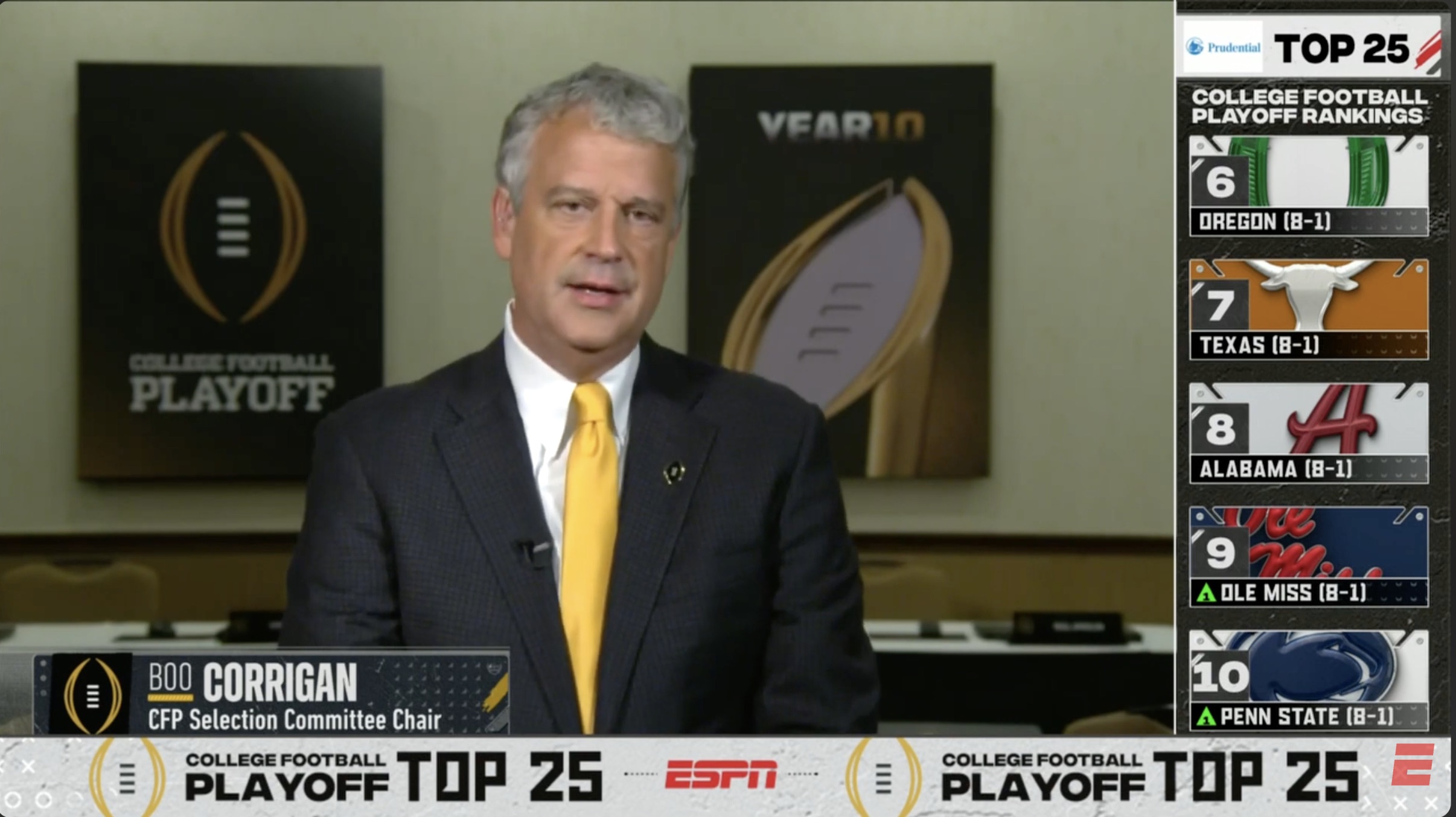
The question is not whether one pin would have changed NC State football. The question is why a man connected to NC State primarily through his family could so naturally carry the brand into a Stanley Cup Final while the university's own chief athletic executive appeared on a national football broadcast without a visible sign of the institution he was employed to lead.
That comparison is partly perception. Perception is still an executive responsibility.
The Hurricanes also understand that player attachment is an asset. Not every player chooses Carolina, and the organization has lost stars it wanted to keep. But multiple players have publicly said they wanted to remain, signed long-term, and described the team and Raleigh as home. Mark Jankowski said he wanted to stay almost from the moment he arrived. Logan Stankoven committed for eight years. Taylor Hall extended after rediscovering his game. Eric Tulsky described players arriving, deciding the organization felt like home, and choosing to become part of its family.36
College football now asks players to make more transactional decisions than ever. Some will transfer. Some will opt out. That is reality. The institutional response cannot be resentment toward athletes. It must be to build a culture, developmental system, fan experience, and economic proposition worth choosing again every year.
The Hurricanes are not proof that every decision works. They are proof that the Triangle is not too small, too transient, or too indifferent to sustain a serious sports enterprise. This market rewards organizations that understand their customers, make bold corrections, and give people something clear to believe in.
NC State has the same market and a deeper reservoir of inherited loyalty. It has simply asked less of itself.
XII. The athletic director is the CEO
Responsibility in college athletics is often diffused until it disappears.
The coach points to NIL. The collective points to donors. The Wolfpack Club points to the project list. The media-rights partner points to the market. The athletic department points to the ACC television contract. University leadership points to athletics. Everyone can produce a reason. No one produces the result.
That is why the athletic director must be treated as the chief executive officer of the enterprise.
The AD does not call the final play at Vanderbilt. The AD hires, retains, and evaluates the person who does. The AD does not personally close every sponsorship. The AD designs the structure, selects the partners, sets the targets, and changes the people when targets are missed. The AD does not personally cultivate every donor. The AD makes sure Athletics, the Wolfpack Club, and university advancement operate from the same priorities. The AD cannot control the ACC's contract. The AD can control whether the department spends a decade complaining about it.
Boo Corrigan has received national recognition and deserves credit for many department-wide achievements. But awards, committee appointments, and Directors' Cup finishes do not answer the football question. The football question is whether the largest commercial platform in the department is stronger, more adaptable, and more competitive because of the decisions made since 2019.
That performance should be evaluated against a scorecard that includes:
- conference winning percentage and championship contention;
- final national rankings and appearances in the expanded playoff;
- wins against ranked and high-resource opponents;
- roster retention and portal acquisition;
- player development by position;
- NIL and revenue-share capacity relative to peers;
- commercial revenue growth beyond conference distributions;
- ordinary-fan satisfaction and capital improvements; and
- the return produced by coaching contracts.
If those metrics are not already reviewed with the chancellor and trustees, that is a governance failure. If they are reviewed and the current results are considered satisfactory, the standard is the failure.
The athletic director is not a caretaker of separate departments. The athletic director is the person responsible for making the parts produce a result.
When the result does not arrive after more than seven years, the answer cannot always be another reorganization beneath the same leadership.
XIII. NC State has failed its own strategic plan
The university has already written the principles required to fix this.
Wolfpack 2030, the university's ten-year strategic plan, says NC State should be agile and flexible, use actionable data, build innovative partnerships, reduce barriers between units, and elevate the university's reputation. It explicitly acknowledges that complex organizational structures and units with different goals can impede collaboration. It calls for central coordination across decentralized partners. It says NC State's brand is a strategic asset with tangible value that can help secure sponsorships and private-sector agreements.37
Apply those sentences to football.
Has Athletics been agile in the portal and NIL era?
Has it used actionable comparative data to decide when a coach's ceiling has been reached?
Has it centrally coordinated Athletics, the Wolfpack Club, Wolfpack Sports Properties, university corporate relations, NIL operations, and outside consultants?
Has it reduced the pain points for companies that want access to NC State's students, research, alumni, and fan base?
Has it maximized the tangible value of the brand?
Has it regularly shown supporters a dashboard measuring progress against public goals?
The university's plan promises transparency and accountability. Football should not be exempt because it is emotionally difficult or politically sensitive. It should be the easiest place to apply those principles because the results, contracts, audiences, and revenue are unusually measurable.
NC State's failure is not that it lacks a philosophy. It is that the athletic enterprise does not appear to live by the one the university already adopted.
"Think and Do" cannot mean think cautiously, form another partnership, preserve every incumbent, and explain later why the money was not there.
XIV. The new chancellor must change the system
Kevin Howell became NC State's fifteenth chancellor in May 2025. He is an alumnus, a former student body president, and a leader whose appointment was praised for relationship-building. Those credentials align directly with the work ahead.38
He should clean house.
That phrase should not be reduced to a demand for indiscriminate firings. Cleaning house means ending the presumption that any leader, contractor, structure, or tradition is entitled to survive an objective review. It means beginning with the outcome NC State wants and rebuilding backward from it.
The chancellor should order a football and commercial-performance review with outside expertise and a public summary. It should cover coaching performance, contract governance, roster investment, NIL, staffing, facilities, fan experience, fundraising, sponsorship, data ownership, and organizational design. It should compare NC State with a carefully selected peer group and account for the old ACC divisional structure when measuring historical results.
Then he should act.
1. Establish a new football operating standard
Sustained Top 25 finishes, regular ACC title contention, credible playoff access, and measurable player development must replace bowl eligibility as the practical definition of success. Publish the standard before another contract negotiation, then hold the department to it.
2. Build a modern football front office
Empower a general manager function that integrates scouting, portal evaluation, retention, revenue sharing, NIL, analytics, and roster planning. Hire coaches who can adapt systems to the personnel NC State can acquire rather than using resource limitations as a permanent alibi.
3. Restore contract discipline
No extension should be automatic. Every agreement should preserve institutional flexibility, tie meaningful upside to breakthroughs, and be evaluated against replacement cost rather than fear. The relevant question is not whether another school might hire NC State's coach. It is whether NC State would struggle to hire another coach capable of producing the same results.
4. Create one commercial command structure
Athletics, the Wolfpack Club, university corporate relations, Wolfpack Sports Properties, and NIL partners should operate from one inventory, one customer record, one annual plan, and one accountable executive.
5. Test every partnership against the market
Conduct a competitive review of Learfield and every other outside partner. The question is not whether a partner owns the largest share of the market. It is whether the arrangement produces the maximum value NC State could reasonably achieve and whether someone is accountable for the inventory it leaves unsold.
6. Publish a Carter-Finley master plan for every fan
Premium revenue must help finance concourses, restrooms, concessions, seating comfort, shade, connectivity, circulation, and basic appearance. Publish the phases, costs, funding sources, timetable, and ordinary-fan dividend attached to every premium project.
7. Publish a commercial and fan-experience scorecard
Report controllable revenue growth, sponsorship inventory sold, major new partnerships, NIL activation, first-time and upgraded donors, fan satisfaction, and progress toward facility commitments. Stop asking supporters to judge progress from press releases about maintenance.
8. Make football the engine for all of NC State athletics
State plainly that football growth is the plan for protecting broad-based athletic excellence. Set targets for the football revenue, sponsorship, attendance, and donor growth required to support athlete revenue sharing and sustain Olympic sports. When football succeeds, the benefits should be visible across the department. When it underperforms, leadership should acknowledge the opportunity cost imposed on every other team.
9. Change leadership when the evidence requires it
If the people responsible for the current trajectory cannot execute the new standard, find people who can. A review without consequences is another consultant. Accountability means accepting that continuity may be the condition preventing progress.
The point of reform is not punishment. It is alignment.
NC State has exceptional students, alumni, fans, academic programs, and regional opportunity. It should not accept an athletic structure that performs as less than the sum of those parts.
Epilogue: Another Rivers, another opportunity
Philip Rivers arrived at NC State in 2000 and changed what the fan base believed was possible. His name is still written across the program's record book and inside the stadium. In February 2026, his son Gunner - a four-star quarterback in the 2027 class - committed to NC State.39
That commitment is a gift. It is also a warning.
No teenager should be asked to rescue an institution from decisions made before he arrived. Gunner Rivers should not inherit a nostalgia project built around his father's name. He should inherit a modern football operation prepared to develop him, retain the players around him, adjust to their strengths, and compete for championships.
In December 2012, NC State lost to Vanderbilt in Nashville while one coaching era ended and another waited to begin. In September 2026, it lost to Vanderbilt in Nashville again, this time on the final play of a game that had already been won in every way except the one that counts.
The symmetry is almost too perfect.
One Vanderbilt loss opened the Dave Doeren era. The other should close the era of thinking that has protected it.
NC State does not need to become Alabama tomorrow. It needs to stop behaving as though becoming the best possible version of NC State is unrealistic. It needs leadership willing to make hard decisions before circumstances make them unavoidable. It needs to value ordinary fans as more than atmosphere, donors as more than annual renewals, corporate partners as more than logos, athletes as more than recruits, and football as more than twelve Saturdays followed by another explanation.
The Vanderbilt loss was not proof that NC State is cursed.
It was proof that the bill has come due.
The new chancellor can pay it by asking supporters for more patience and more money while preserving the same structure.
Or he can decide that the next Rivers will arrive at a different NC State than the one his father left behind.
That choice - unlike the bounce of a fumble in Nashville - is entirely within our control.
The record
Source notes
The argument is forceful by design. The factual claims are documented by primary reporting, university records, official announcements, and public materials.
- Associated Press, “Music City Miscue gives Vanderbilt a win over NC State no one saw coming,” September 19, 2026; NC State Athletics, Vanderbilt game recap, September 19, 2026. Source ↗ and Source ↗
- NC State Athletics, “NC State Football's History of Success”; 2023 NC State Football Media Guide. Source ↗ and Source ↗
- Fox Sports, “NC State fires Tom O'Brien as coach.” Source ↗
- Fox Sports, “N.C. State's Yow begins coaching search.” Source ↗
- NC State Athletics, “Dave Doeren to Lead Wolfpack Football,” December 1, 2012. Source ↗
- Vanderbilt Athletics, 2012 Music City Bowl review and statistics. Source ↗
- NC State Athletics, Dave Doeren biography; NC State Athletics, 2025 Gasparilla Bowl recap. Source ↗ and Source ↗
- WRAL, reporting on Doeren's 2024 extension; 2025 NC State Football Media Guide. Source ↗ and Source ↗
- WRAL, reporting on Doeren's initial contract. Source ↗
- NC State Athletics and WRAL reports on the 2019, 2021, 2022, 2023, and 2024 extensions. Source ↗, Source ↗, Source ↗, Source ↗, and Source ↗
- WRAL, “NC State's Dave Doeren receives contract extension through 2029,” April 2024. Source ↗
- NC State Athletics, “NC State Names Boo Corrigan Director of Athletics,” January 30, 2019. Source ↗
- NCAA materials on the transfer rule and the history of college athletics. Source ↗ and Source ↗
- NC State Athletics, “Accelerate Sports Ventures Chosen as NIL Consultants,” March 23, 2023; NC State Athletics 2024-25 Annual Report. Source ↗ and Source ↗
- NC State Athletics 2024-25 Annual Report. Source ↗
- Carolina Hurricanes, “Canes Name Tulsky Permanent General Manager.” Source ↗
- Associated Press coverage of Carolina's 2026 Stanley Cup championship. Source ↗
- Atlantic Coast Conference, 2021 football standings. Source ↗
- Louisville Athletics, “No. 10 Cardinals Clinch Spot in ACC Championship,” November 18, 2023. Source ↗
- Virginia Tech Athletics, announcements concerning the 2025 leadership transition and James Franklin hiring. Source ↗ and Source ↗
- Kansas State Athletics, West Stadium Center and Shamrock Zone materials. Source ↗ and Source ↗
- Iowa State Athletics, Sports Performance Center, CyTown, and MidAmerican Energy Field announcements. Source ↗, Source ↗, and Source ↗
- Utah Athletics, “Ribbon Is Cut on Ken Garff Red Zone at Rice-Eccles Stadium,” August 12, 2021. Source ↗
- NC State Board of Trustees, February 2026 Audit, Risk Management, and Finance Committee meeting materials. Source ↗
- NC State Centennial Campus partner information; NC State College of Engineering facts and rankings. Source ↗ and Source ↗
- NC State Athletics, corporate sponsorship information. Source ↗
- Iowa State Athletics, Vanderbilt Athletics, and Associated Press reporting on naming rights and on-field commercial marks. Source ↗, Source ↗, and Source ↗
- NC State Athletics, “NC State to Partner with ISE,” November 25, 2024. Source ↗
- Learfield, NC State Wolfpack property page; NC State Athletics, corporate sponsorship information. Source ↗ and Source ↗
- Virginia Tech Athletics, Playfly announcement; Sports Business Journal, Nebraska-Playfly reporting; Fresno State Athletics, Bulldog Sports Enterprises announcement. Source ↗, Source ↗, and Source ↗
- NC State Athletics 2024-25 Annual Report. Source ↗
- NC State Athletics 2024-25 Annual Report. Source ↗
- Carolina Hurricanes, Lenovo Center renovation update; Associated Press coverage of the 2026 Stanley Cup. Source ↗ and Source ↗
- NHL.com, “Brind'Amour shows he's part of 'Wolfpack family' with NC State hat,” June 2026. Source ↗
- User-supplied screenshot of Corrigan's ESPN College Football Playoff Top 25 appearance. The visible pin, backdrop, and lower-third are CFP-branded; no NC State identifier is visible.
- Carolina Hurricanes and NHL.com features on Mark Jankowski and Carolina's roster culture. Source ↗ and Source ↗
- NC State University, Wolfpack 2030: Powering the Extraordinary. Source ↗
- NC State University, “Kevin Howell Named NC State's 15th Chancellor,” March 18, 2025. Source ↗
- ESPN, “Four-star QB Gunner Rivers, son of Philip Rivers, commits to NC State,” February 2026. Source ↗